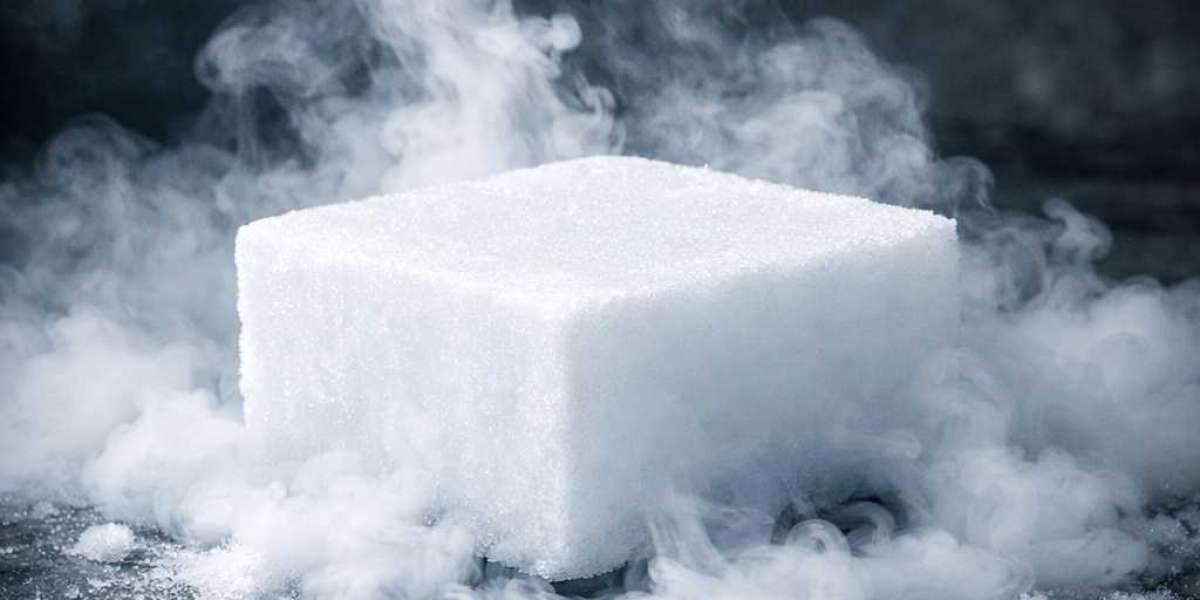

The dry ice market, advancing from US$ 691.91 million in 2025 toward US$ 1,182.37 million by 2034 at a CAGR of 6.10% as per The Insight Partners, is segmented across product form and application dimensions whose commercial distinctions reflect genuine technical requirements rather than arbitrary classification choices. The Dry Ice Market Segmentation analysis maps these dimensions across a market where four application categories each create distinct procurement behaviors and growth patterns.
Blocks hold the largest product type share, and the thermodynamics explain why. A dry ice block has lower surface area relative to its mass compared to the same weight of pellets, which means it sublimates more slowly and provides longer temperature maintenance per kilogram purchased. In storage applications where a shipper needs temperature control maintained over 24 to 48 hours of transit without resupply, blocks' extended sublimation duration creates logistical efficiency that pellet formats cannot match. Standard dry ice blocks at roughly 27 kilograms provide industrial shippers with predictable temperature maintenance windows that they can plan shipment routing around. Linde PLC and Continental Carbonic Products supply block format dry ice to commercial shippers and industrial users through regional distribution infrastructure.
Pellets serve a different application logic. The small cylindrical or spherical form of pellet dry ice, typically ranging from 3 to 16 millimeters in diameter, creates much higher surface area per unit mass that accelerates sublimation and CO2 gas release, which is exactly the property needed for dry ice blasting applications where CO2 pellets are propelled at cleaning surfaces to dislodge contamination through kinetic impact combined with rapid thermal shock from the minus 78.5 degree surface contact. Pellet dry ice is also the format of choice for parcel shipping of perishable consumer goods, where small quantities packed around the product in an insulated box provide the hours of cooling needed for consumer delivery without requiring the handling equipment that block formats need.
Check valuable insights in the Dry Ice Market report. You can easily get a sample PDF of the report https://www.theinsightpartners.com/sample/TIPRE00019661
Key Market Players
- Polar Ice
- Continental Carbonic Products, Inc.
- Sicgil India Limited
- Linde PLC
- Dry Ice UK Ltd.
- Dry Ice Corp
- Reliant Dry Ice
- CryoCab
- Praxair Technology, Inc.
- ACP
Storage and transportation is the largest application by revenue, anchored in commercial freight cold chain for seafood, meat, pharmaceutical products, and industrial samples requiring temperature-maintained shipment. The application's scale reflects the global cold chain market's overall growth trajectory, where increasing cross-border trade in perishables and growing pharmaceutical distribution complexity are both expanding the volume of temperature-controlled freight that requires dry ice as the cooling medium when refrigerated transport is unavailable, impractical, or cost-prohibitive.
Food and beverages is the fastest-growing application, driven by the e-commerce food delivery revolution and the meal kit sector's scale-up. Healthcare is growing through pharmaceutical distribution needs and clinical sample transport requirements. Industrial applications encompass dry ice blasting for machinery cleaning, fire suppression systems using CO2 discharge, semiconductor manufacturing process cooling, and specialty manufacturing environments where contamination-free cooling is specified.
Frequently Asked Questions (FAQs)
Q1. What application-specific advantage determines whether pellets or blocks are specified for a dry ice procurement program?
Blocks' lower surface-area-to-mass ratio creates longer sublimation duration per kilogram, favoring extended transit storage and industrial bulk cooling applications, while pellets' higher surface area accelerates sublimation and CO2 release, suiting dry ice blasting applications requiring rapid thermal contact and parcel shipping applications where small quantities in insulated boxes need to provide consumer delivery cooling windows without the handling infrastructure that block formats require.
Q2. What industrial application is creating above-average dry ice pellet demand beyond food and pharmaceutical sectors?
Dry ice blasting for industrial equipment cleaning propels CO2 pellets at contaminated surfaces through compressed air systems, removing grease, paint, rubber, ink, and biological fouling through a combination of kinetic impact and rapid thermal shock without water, chemicals, or abrasive media that require secondary cleanup, creating demand from automotive manufacturing, food processing facility maintenance, aerospace component cleaning, and power generation equipment restoration programs where residue-free contamination removal is specified.
About The Insight Partners
The Insight Partners is a one stop industry research provider of actionable solutions. We help our clients in getting solutions to their research requirements through our syndicated and consulting research services. We specialize in industries such as Semiconductor and Electronics, Aerospace and Defense, Automotive and Transportation, Biotechnology, Healthcare IT, Manufacturing and Construction, Medical Devices, Technology, Media and Telecommunications, Chemicals and Materials.
Contact Us
The Insight Partners
Phone: +1-646-491-9876
E-mail: sales@theinsightpartners.com