
Industries across the world are reassessing their filtration strategies as environmental regulations tighten and operational efficiency becomes a top priority. In this evolving landscape, ceramic membranes are emerging as a powerful solution for high-performance separation and purification processes. Known for their durability, chemical stability, and resistance to extreme temperatures, these membranes are increasingly being adopted across sectors that require reliable filtration under demanding conditions.
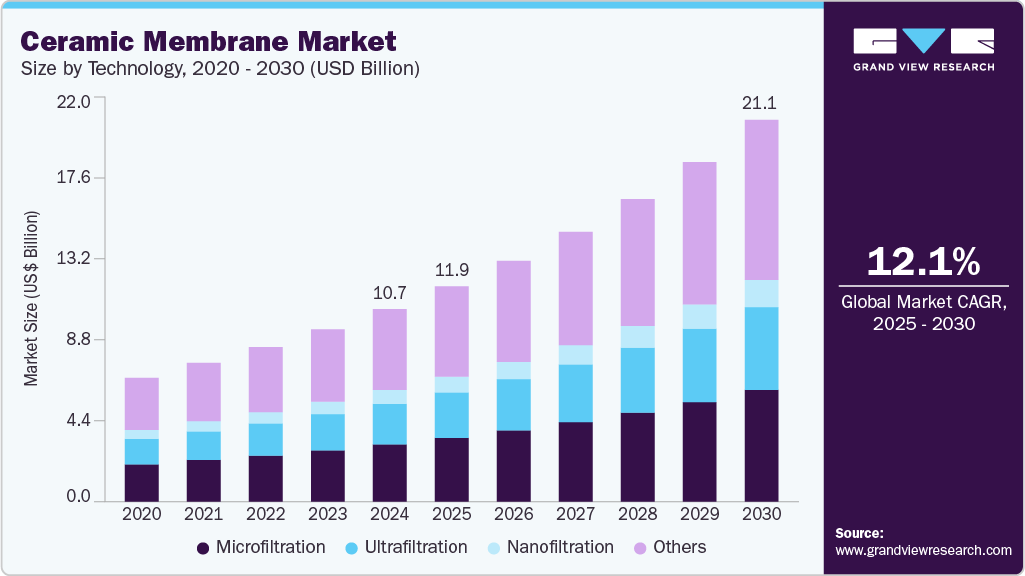
Market indicators reflect this growing demand. The global ceramic membrane market size was estimated at USD 10.67 billion in 2024 and is projected to reach USD 21.17 billion by 2030, growing at a CAGR of 12.1% from 2025 to 2030. The expansion is closely linked to the rising use of ceramic membranes across industries such as food and beverage processing, pharmaceuticals, chemicals, biotechnology, and water and waste management. As manufacturing sectors intensify their focus on sustainability and resource efficiency, membrane technologies are playing a larger role in optimizing separation processes.
Industrial Wastewater Treatment Driving Adoption
One of the most important drivers behind this growth is the increasing demand for ceramic membranes for industrial wastewater treatment. Industries such as textiles, chemicals, mining, and oil refining generate complex wastewater streams that often contain oils, heavy metals, dyes, and suspended solids. Conventional filtration systems can struggle with such challenging conditions, leading to higher maintenance costs and inconsistent performance.
Ceramic membranes offer a strong alternative due to their robust structure and long operational lifespan. Unlike polymer-based membranes, ceramic membranes can tolerate aggressive chemicals, high pressure, and elevated temperatures without significant degradation. This resilience makes them particularly suitable for continuous industrial operations where downtime can be costly.
The use of ceramic membranes for industrial wastewater treatment is enabling companies to recover water, reduce pollutant discharge, and comply with environmental regulations more effectively. In many cases, membrane filtration systems are integrated into closed-loop water management strategies, allowing manufacturers to recycle process water and significantly lower freshwater consumption.
Innovation Redefining Ceramic Membrane Performance
Technological advancements are also accelerating the adoption of ceramic membrane systems. Research in nanoporous structures and advanced material engineering is improving filtration precision while increasing permeability. New-generation ceramic membranes can separate particles at extremely small scales, allowing them to remove contaminants that conventional filtration technologies may miss.
Another major innovation involves anti-fouling surface treatments. Fouling occurs when contaminants accumulate on membrane surfaces, reducing filtration efficiency over time. To address this challenge, researchers and ceramic membrane manufacturers are developing coatings and surface modifications that minimize particle adhesion and extend membrane lifespan.
Energy efficiency is another area of active development. Improved membrane designs are helping reduce pressure requirements and operating energy, making ceramic filtration systems more economically attractive for large-scale industrial applications.
These technological improvements are particularly relevant in sectors such as pharmaceuticals and biotechnology, where precise molecular separation is required. Similarly, the food and beverage industry is increasingly relying on membrane filtration for applications such as dairy processing, beverage clarification, and ingredient purification.
Expanding Applications Across Industrial Sectors
The versatility of ceramic membranes continues to unlock new industrial opportunities. In the chemical sector, ceramic filtration systems are used to separate catalysts, recover valuable chemicals, and purify process streams. Mining companies utilize ceramic membranes to treat wastewater and recover minerals from tailings. Meanwhile, in biotechnology and pharmaceutical production, membranes play a critical role in sterilization and high-purity filtration processes.
Municipal water management systems are also beginning to incorporate ceramic membrane technology to improve reliability in water treatment plants. The long service life of ceramic materials makes them particularly attractive for infrastructure projects where maintenance intervals must be minimized.
As global industries transition toward more sustainable production models, the demand for durable and high-efficiency filtration technologies is expected to grow steadily. Ceramic membranes are well positioned to meet this demand due to their combination of strength, precision, and operational stability.
Leading Companies Shaping the Ceramic Membrane Market
The ceramic membrane market is supported by several established technology providers that continue to invest in innovation, production capacity, and global partnerships. These companies play a key role in advancing membrane technologies and expanding their industrial applications.
Key companies operating in the ceramic membrane market include:
- GEA Group Aktiengesellschaft
- Pall Corporation
- Hyflux Ltd
- Kovalus Separation Solutions
- Nanostone
- Veolia
- TAMI Industries
- METAWATER Co., Ltd.
- ITN Nanovation AG
- SIVA Unit
These organizations have developed extensive expertise in membrane engineering, system integration, and industrial filtration solutions. Their ongoing investments in research and development are helping push the boundaries of membrane performance while making the technology accessible to a wider range of industries.
The Future Outlook for Ceramic Membrane Manufacturers
Looking ahead, the ceramic membrane sector is expected to grow rapidly as industries continue prioritizing water conservation, regulatory compliance, and operational efficiency. For ceramic membrane manufacturers, innovation in material science, membrane architecture, and system design will remain essential to meeting evolving industrial demands.
With global water resources under increasing pressure and industrial processes becoming more complex, advanced membrane technologies will play a central role in the future of filtration. Ceramic membranes, with their durability and high separation efficiency, are poised to become a cornerstone of modern industrial water treatment and separation systems.